Automotive ECU Platform Porting & Migration
Move your ECU software from one microcontroller or processor to another — retain behavior, hit timing targets, and validate on-target with OEM-ready quality.
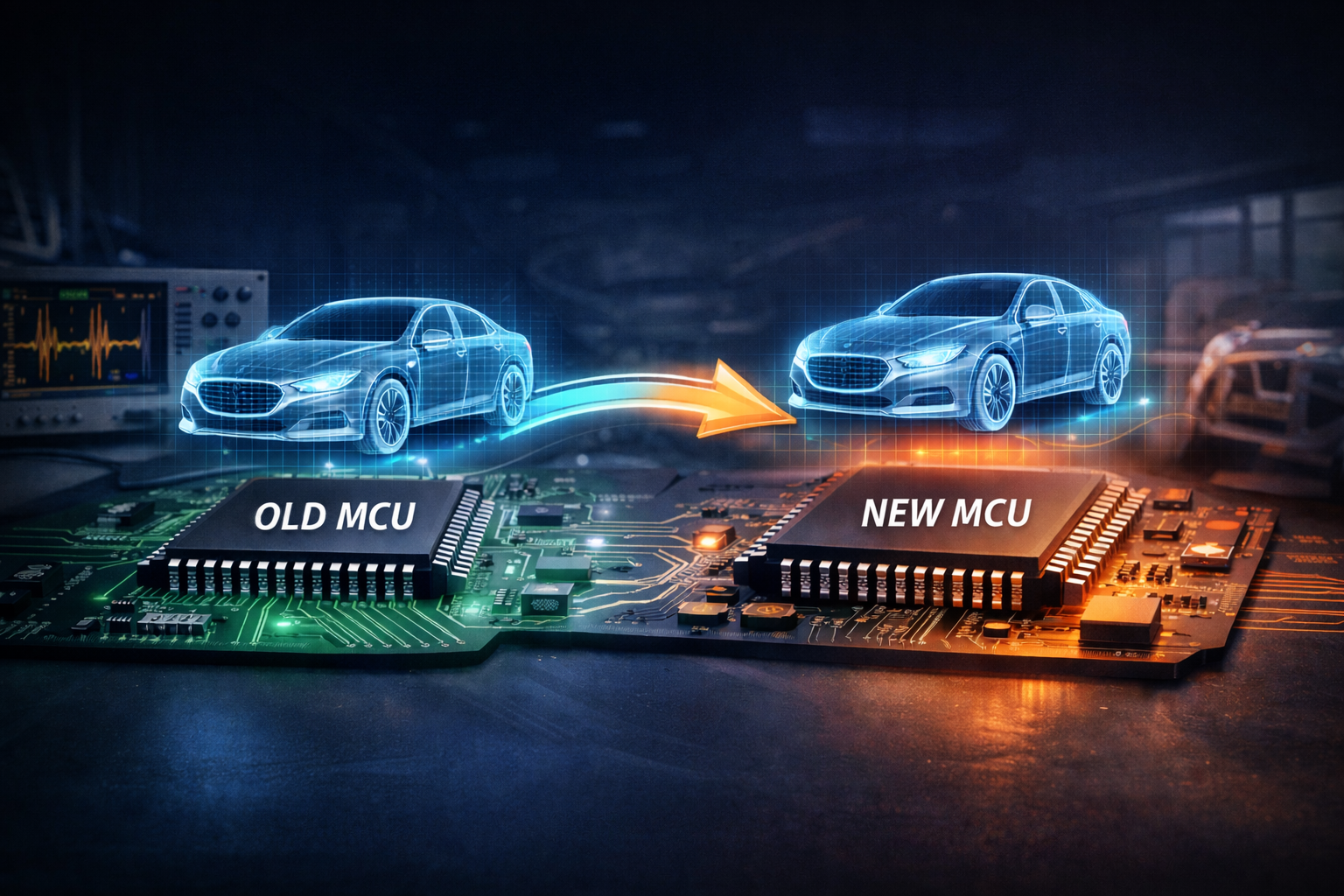
Platform porting is about preserving ECU behavior while adapting to new silicon, toolchains, peripherals, and performance constraints.
We help automotive teams migrate ECU software from one microcontroller or processor to another — across MCU families, SoCs, or upgraded variants. Whether your stack is AUTOSAR or non-AUTOSAR, we handle the bring-up, low-level adaptations, integration changes, and full regression validation needed to meet OEM/Tier-1 expectations.
Our focus is predictable delivery: clear gap analysis, controlled change sets, measurable timing and resource targets, and test evidence that the migrated platform is stable, secure, and production-ready.
From hardware bring-up to software integration, tuning, and validation — we cover every step of the migration lifecycle.
Migration Planning & Gap Analysis
- Current platform assessment: architecture, interfaces, timing, memory, constraints
- Delta identification: peripherals, drivers, OS, comms, diagnostics, security, toolchain
- Risk-based migration plan with milestones and validation checkpoints
Low-Level Porting (BSP / MCAL / Drivers)
- BSP bring-up: clocks, interrupts, memory map, startup, linker scripts
- MCAL/driver integration & configuration for new MCU/SoC
- Peripheral migration: ADC/PWM/SPI/I2C/GPIO/timers, watchdog, NVM, flash drivers
AUTOSAR & Middleware Adaptation
- AUTOSAR BSW/RTE updates for new MCAL and ECU constraints
- CDD integration or rework for new peripherals
- Comms stack updates: CAN/CAN FD/LIN/Ethernet, network management, diagnostics
Security & Boot Chain Continuity
- Secure boot and flashing flow adaptation for new silicon
- HSM/crypto integration and key/seed workflow alignment
- Support for UDS bootloading and secure update mechanisms
Performance Tuning & Validation
- Timing closure: task scheduling, ISR latency, CPU load, memory footprint optimization
- Regression and integration testing with full traceability
- Hardware-in-loop / bench validation and issue triage support
Purpose-built expertise spanning silicon bring-up, software stack adaptation, and production-grade quality evidence.
Bring-Up & Board Support
Startup and memory mapping • clock/reset configuration • interrupt setup • linker scripts • boot modes • peripheral enablement • debug and trace readiness for early bring-up stability.
Stack Integration
AUTOSAR or non-AUTOSAR integration • driver/MCAL configuration • middleware adaptation • comms and diagnostics alignment • calibration and NVM consistency across platforms.
Quality & Evidence
Controlled change sets • repeatable builds • regression test strategy • timing and memory reports • release notes and handover package to production teams.
Toolchain & Debug Readiness
Integration across common automotive toolchains and debuggers with step-by-step build/run documentation, trace capture support, and stable dev workflows for multi-team projects.
Proven experience with the most common automotive compute platforms and communication stacks.
Target Platforms
Infineon AURIX TC2xx / TC3xx • Renesas RH850 • TI TDA4 • NXP S32 (MCU/Gateway families)
Communication
CAN • CAN FD • LIN • Automotive Ethernet • FlexRay (as required by program)
Security
Secure boot • HSM/crypto integration • Secure update and diagnostics (UDS) workflows
Toolchains
TASKING, GCC, GreenHills, Lauterbach TRACE32, Vector DaVinci, MATLAB/Simulink-based stacks
Structured deliverables that help your team integrate, test, and release confidently — ready for OEM and Tier-1 review.
Migration Blueprint
- Gap analysis & risk log
- Porting plan with milestones
- Interface mapping and assumptions
Bring-Up Package
- BSP/MCAL integration and configuration
- Build + flash steps and debug guides
- Known limitations and next actions
Timing & Resource Reports
- CPU load and latency measurements
- Memory footprint and stack usage
- Optimization recommendations
Validation Evidence
- Regression test results and logs
- Issue triage notes and fix traceability
- Release notes and handover pack
Our approach is rooted in automotive rigor — every phase has clear inputs, outputs, and validation gates before moving forward.
Assess & Plan
Structured gap analysis — interfaces, peripherals, timing, memory, and toolchain — then define a migration path with clear checkpoints and risk log.
Bring-Up & Integrate
Bring up the new platform, integrate BSP/MCAL/drivers, and stabilize core services — comms, diagnostics, NVM, watchdog, safety hooks — for consistent ECU behavior.
Close Performance Gaps
Tune scheduling and resource usage, ensure timing closure, and optimize runtime behavior on the new MCU/SoC against targets.
Validate & Handover
Execute regression and integration tests, document deviations, and deliver a clean handover package ready for OEM/Tier-1 workflows.
Three core strengths that make IAST the right partner for your platform migration program.
Predictable Migration
Clear plan, measurable checkpoints, and controlled change sets — so porting doesn't turn into an endless loop of rework and re-testing.
Automotive-Grade Rigor
We work with OEM expectations in mind: diagnostics, traceability, stability, and full validation evidence ready for program review.
Performance & Stability Focus
Timing closure, memory footprint control, and robust bring-up — so the new platform performs like production software from day one.
Fast Ramp-Up, Clean Handover
We deliver with practical documentation and an engineer-friendly handover package — so your internal teams can continue development and releases without friction.
Need to migrate your ECU software to a new MCU/SoC?
Let's port, stabilize, and validate your platform with predictable delivery and OEM-ready quality.